

27.04.2026

On Pagaruyung, Negeri Sembilan, and the roots we return to in time of current Negeri Sembilan state crisis

When crisis strikes, men return to their roots, through the lens of Negeri Sembilan's present crisis and one editor's personal reckoning with lineage, legacy, and what it truly means to carry old blood.
Words: Raja Izz


There is a particular kind of clarity that arrives only in deep disappointments. It is in precisely these moments that a man is forced to ask within him the oldest question available to them: Who am I, and where do I come from?

I have asked that question twice in my adult life with full seriousness.

The first was 10 years ago, when what should have been a reception was cancelled under circumstances that felt, at the time, like a public humiliation. I found myself quietly turning inward. Not to self-pity, but to lineage. To the weight of a bloodline that had survived far worse. It steadied me in a way that no external validation ever could have.

The second time is now.

As Negeri Sembilan, finds itself in a crisis between its Undang and the people's elected representatives, I feel that same gravitational pull toward origin. Toward the source. Because Negeri Sembilan is not merely a state on a map. It is a civilisational idea. And to understand what is at stake in its present turbulence, one must travel — as I recently did in thought and research — all the way to Pagaruyung, the ancestry of modern Negeri Sembilan, its ruler and its people.

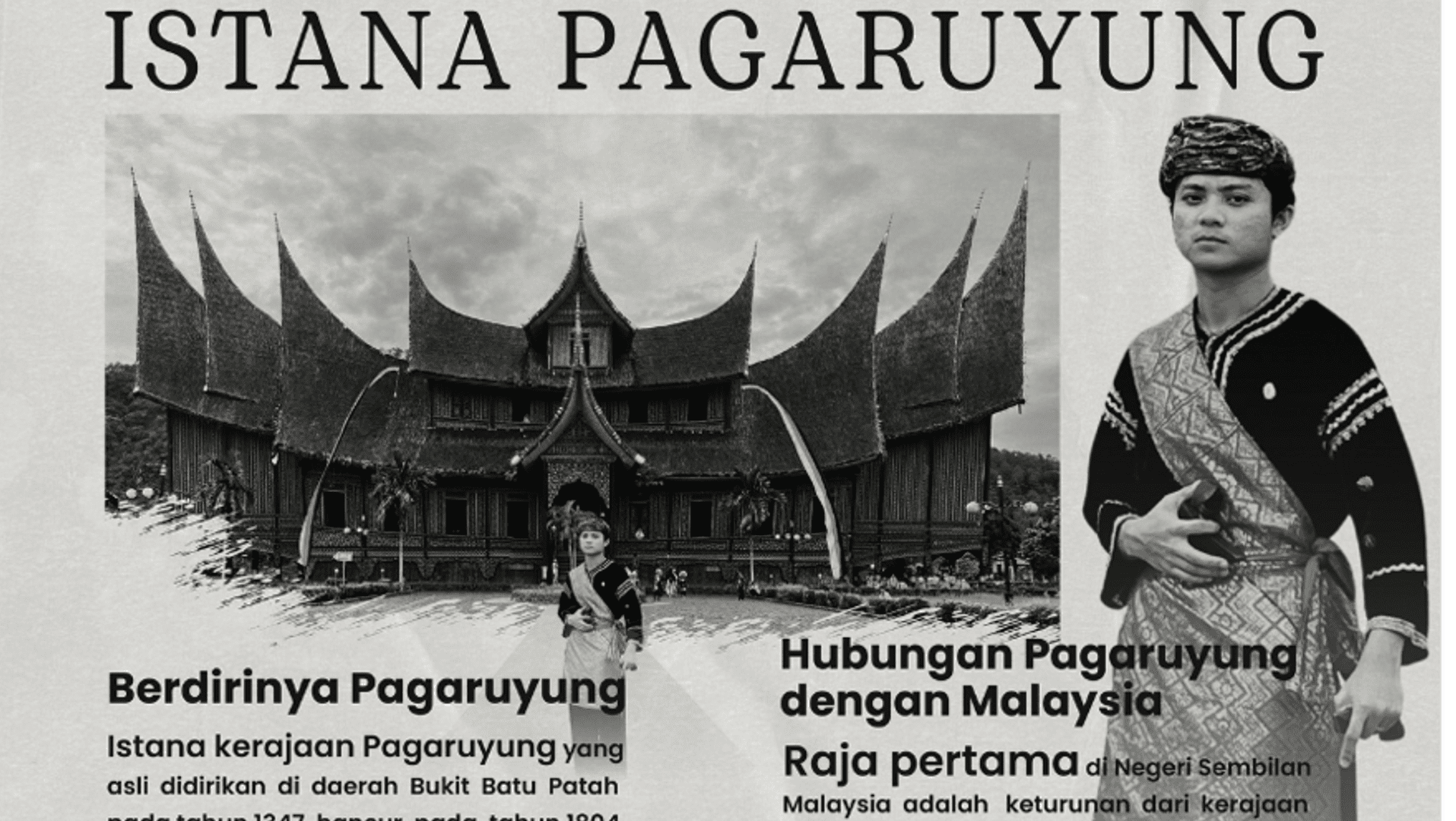
Sir Stamford Raffles and Istana Pagaruyung (Pagaruyung Royal Palace).

GC Illustration.


The Question Raffles Could Not Shake

It was in July 1818 that Sir Stamford Raffles led an expedition inland from Padang on the western coast of Sumatra, making his way into the Minangkabau highlands toward the ancient seat of the Pagaruyung kingdom. He brought with him his wife, the naturalist Dr. Thomas Horsfield, 200 porters, and 50 British soldiers. He also brought a thesis he had been developing since at least 1809, when he submitted a literary essay to the Asiatic Society arguing that the Malays constituted a distinct language-based nation spread across the Eastern Archipelago.

What Raffles found at Pagaruyung confirmed him in his conviction, even as it broke his heart.

The palace had been burned to the ground three times by the Padri — a puritanical Islamic reform movement then at war with the Adat aristocracy. Rebuilt after the first two fires, it was abandoned after the third. Raffles arrived to find little more than waringin trees standing where a royal court had once held sway. The dynasty he had come to honour had been nearly exterminated three years earlier, in 1815, when most of the Minangkabau royal family were massacred on the orders of Tuanku Lintau.

And yet Raffles did not revise his thesis. He deepened it. Upon concluding his expedition, he declared Pagaruyung to be:

"the source of that Malay power, the origin of Malay nation, so extensively scattered over the Eastern Archipelago."

Why? What could a burned palace and a nearly exterminated royal line possibly confirm about civilisational greatness?

Rome conquered Greece (c. 214–146 BC). Though Rome won militarily, it absorbed Greek culture deeply.


Athens Does Not Need to Stand to Have Founded Rome

I have come to think of Raffles's insight the way one thinks of the relationship between Athens and Rome, and through Rome, the whole of Western civilisation.

Athens was conquered, sacked, diminished. Its physical glory was reduced. And yet Rome called itself the inheritor of Greek thought, Greek aesthetics, Greek philosophy. The greatness of Athens was not measured by what remained standing, but by how far its influence had dispersed, taken root, and flowered in the institutions and bloodlines of peoples who had never set foot on its soil.

Pagaruyung is the Athens of the Malay world.

Along the journey through the Minangkabau interior, Raffles documented a civilisation of unexpected sophistication. He marvelled at bamboo-constructed water wheels used to irrigate paddy fields — a technology he considered a wholly indigenous Minangkabau invention, noting he had never encountered anything comparable in Java despite Java's centuries of contact with China and Europe. He found extensive sugarcane plantations on hillside terraces, with twin-cylinder mills powered by buffalo producing refined sugar. He noted that by 1818, an estimated 1,200 gold mining sites had been worked across the region, lending tangible meaning to the kingdom's ancient name: bumi emas, the land of gold.

But what moved Raffles most was not the technology. It was the dispersal. Pagaruyung's princes and princesses had not merely ruled West Sumatra. They had radiated outward across the entire archipelago, founding royal houses from Perak to Sungai Ujong, Megat Terawis to Raja Melewar, from Rembau to Jelebu, establishing systems of governance, adat, and matrilineal succession that survive, recognisably, to this day.

The Pagaruyung Palace is not just a historical building, but it also serves as a powerful symbol of Malay identity and culture. (Photo: Moonstar)


Negeri Sembilan Is the Living Proof

Raffles understood this personally. While administering the Malay Peninsula, he met descendants of the Pagaruyung royal house, and so moved was he by their legitimacy that he considered appointing the Yang Dipertuan Ali Alamsyah, of whom he identified as a direct descendant of the Minangkabau king, as ruler under British protection.

The Minangkabau princes who settled Negeri Sembilan brought with them not merely their bloodline but an entire governance philosophy: adat perpatih, a system of matrilineal descent, consensus-based decision-making through the Undang, and a constitutional understanding that power is a covenant. It is, in its essence, the most sophisticated pre-colonial model of accountable governance in the Malay Peninsula.

This is the inheritance now under strain.

The current crisis in Negeri Sembilan in April 2026, the tension between the Undang as custodians of adat authority and the elected representatives of the people, is not merely a political dispute. It is a question about which layer of civilisation takes precedence when the two come into conflict at the same time. It is the same question that tore Pagaruyung apart from within before the Padri ever arrived with their torches.

Istano Basa Pagaruyung the new palace, built after the 2007 fire.


What the Ruins Teach

What I take from Raffles's expedition and from my own personal moments of returning to lineage in crisis is this: the palace burning does not end the civilisation. The dispersal of the royal family does not conclude the story of the bloodline. If anything, it proves what was always true: that the power was never in the palace. It was in the people who carried the idea of the palace wherever they went.

Pagaruyung burned. And its princes became the founders of Negeri Sembilan's royal houses. The adat survived. The matrilineal system survived. The philosophy of governance as covenant survived. It crossed the Straits of Melaka and took root in a new soil, where it has stood through colonialism, through independence, through every manner of political upheaval, for centuries.

This is what it means to carry old blood. Not a guarantee of comfort or recognition. Not immunity from crisis. But a depth of roots that crisis cannot reach.

When I trace my lineage through Tunku Ahmad Tunggal to the fifth Yamtuan Besar of Negeri Sembilan from my father side, and through Tuanku Muhammad ibni Tuanku Antah from my grandmother side, and through him back to the Minangkabau royal line that Raffles himself identified as the origin of Malay civilisational power, I do not feel the weight of ancestry as a burden. I feel it as what it has always been: a compass. One that points not to the past, but through it.

The palace at Pagaruyung was rebuilt twice before it was finally abandoned. Negeri Sembilan, in its present crisis, is perhaps facing its own moment of third burning. The question is not whether the fire can be stopped.

The question is what we carry out of it.


Sources:

Memoir of the Life and Public Services of Sir Thomas Stamford Raffles (Lady Sophia Raffles, 1835); "Malay Race," Wikipedia; "Pagaruyung Kingdom," Wikipedia; Expedisi Sir Thomas Stamford Raffles ke Minangkabau tahun 1818 (Anton Hilman, hilman.web.id); Mengikuti Perjalanan Raffles Menemukan Desa Emas di Minangkabau (Good News From Indonesia, 2021); The History of Sumatra (William Marsden, 1784).

About the Author

YM Raja Izz

Raja Izz (MBA) is the co-founder and Editor-in-Chief of Gentleman's Code (GC), a publication devoted to elegance, cultivated taste, and the art of refined living.

Since its founding in 2018, under Raja Izz’s discerning guidance, GC has achieved distinction on the global stage: honored at the LUXLife 9th Annual LUX Global Excellence Awards 2025 as Men’s Luxury & Culture Thought Leaders of the Year – Asia, and lauded as one of the Top 20 Digital Men’s Magazines on the Web by Feedspot for five consecutive years.

He builds the platform - for others to rise, for noble values to return, and for men to remember who they once aspired to be.

Related posts