

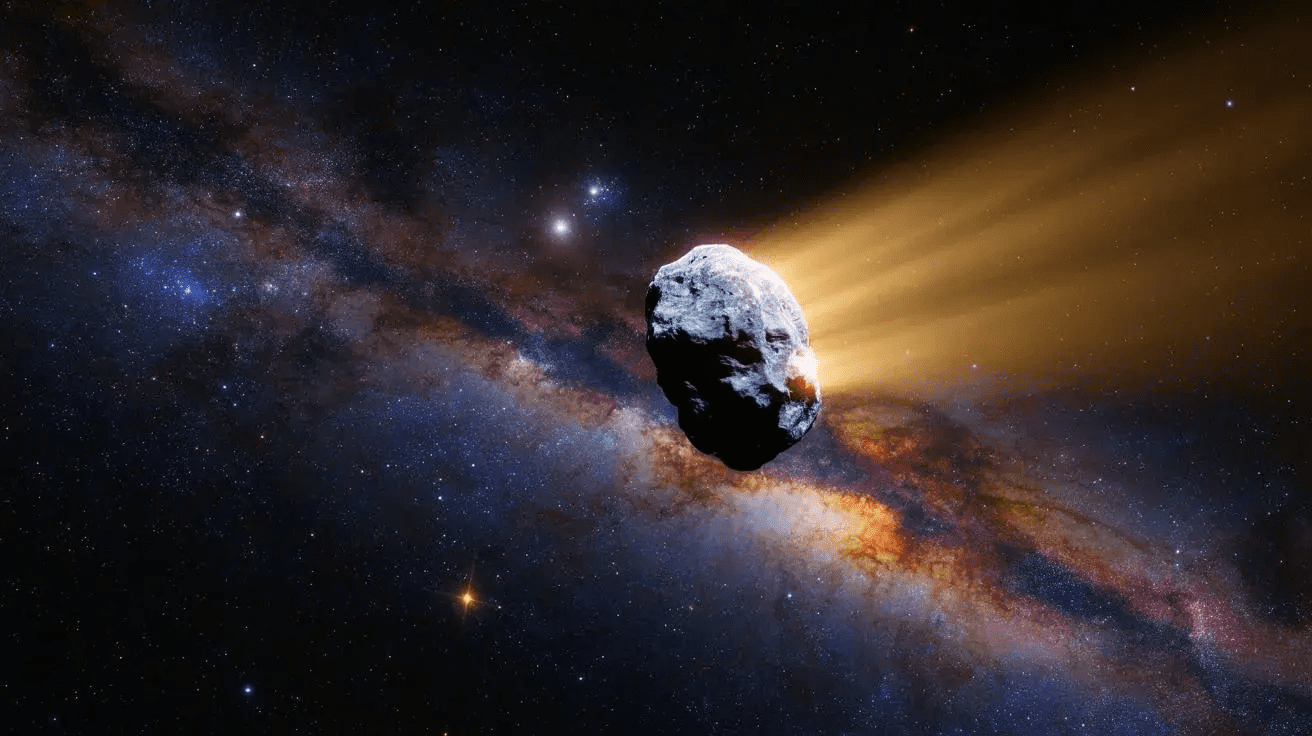
Illustration of interstellar comet 3I/ATLAS journeying through space, created by artificial intelligence.
Words: Raja Izz
What if our solar system's most elegant guest isn't human?
For months now, astronomers have been tracking something unusual. Its name is 3I/ATLAS - an interstellar object cutting through our cosmic neighborhood with uncommon grace. Officially, scientists call it a comet. Frozen debris from another star, they say. A wanderer bound by physics and chance.
But its route suggests something more intriguing.
The path of 3I/ATLAS reads like an itinerary. A carefully considered journey through the inner Solar System's most significant landmarks. And for those willing to entertain the thought, it bears an uncanny resemblance to something deeply gentleman: the Grand Tour.
A c. 1760 painting of James Grant, John Mytton, Thomas Robinson and Thomas Wynne on the Grand Tour by Nathaniel Dance-Holland.
In the 18th and 19th centuries, Europe's young aristocrats undertook a rite of passage before assuming positions of influence. They embarked on the Grand Tour - a cultural pilgrimage across the continent's great capitals. Rome for classical heritage. Florence for Renaissance. Paris for art and philosophy. Vienna for music and court refinement. London for commerce and empire.
This wasn't tourism. It was education through immersion. These travelers absorbed languages, studied architecture, observed political systems, and cultivated the discernment required of leadership. They returned home transformed - worldly, sophisticated, prepared to govern.
The Grand Tour was built on a simple principle: true understanding requires direct observation. Maps and books teach only so much. To truly know a place, one must move through it with intention and awareness.
Now consider what 3I/ATLAS has done and about to do.
Animation of comet 3I/ATLAS's trajectory through our solar system.
NASA/JPL
Its trajectory is striking.
First, it swept past Mars- a world that once held water, perhaps life, now preserved in geological memory.
Next came Venus, Earth's twin - similar in size but catastrophically different in outcome. A cautionary tale wrapped in acid clouds and crushing heat.
And on 30 October, 3I/ATLAS approaches the Sun itself. The throne of our system. The nuclear furnace that powers every world, drives every climate, sustains every living thing.
Then it is expected to glide near Jupiter, the undisputed sovereign of our Solar System. The gas giant that shapes orbital mechanics with its immense gravity, commanding moons and asteroids like a celestial court.
If this path is pure coincidence, it is a remarkable one. But if deliberate - if beneath its icy surface lies the technology of an advanced civilization - then we are witnessing something profound: an interstellar intelligence performing its own version of a Grand Tour, surveying the worlds of our solar system as the young aristocrats once toured the capitals of Europe, as part of the education of gentlemen.
William Beckford's 1780-1781 Grand Tour through Europe shown in red. Every other 18th and 19th century young aristocrats and landed gentry man of sufficient means and rank – embarked on this legendary adventure: The Grand Tour from London to Paris to Vienna to Florence to Rome.
The idea may sound extravagant, but its elegance lies in its symmetry.
Throughout human history, the act of observation has been synonymous with intellect. The gentleman studied art before creating it, politics before practicing it, and the world before ruling it. If 3I/ATLAS behaves as such - arriving, observing, then leaving without intrusion - it displays precisely the same manners once associated with civilization’s highest ideals: restraint, discernment, and discretion.
To the modern world, obsessed with exposure and immediacy, such conduct feels almost alien. Yet that is precisely the point. The truly sophisticated do not announce their presence; they glide quietly through the noise, learning before revealing, mastering before intervening.
Perhaps 3I/ATLAS embodies that very code of elegance?
The thought is both humbling and unsettling. If this visitor possesses intelligence, then it understands something fundamental about civilization: that knowledge precedes contact, and observation precedes revelation.
It would mean we're being studied by something that grasps timing, hierarchy, and discretion. Values we've long associated with sophistication and power.
A labeled map showing the path interstellar comet 3I/ATLAS will take through our solar system.
(Image credit: ESA)
Skeptics will dismiss this as fanciful thinking. And they're not wrong to demand evidence. Science has detected no propulsion systems, no communication signals. The data shows chemistry and momentum - nothing more.
But scientific caution shouldn't eclipse its significant anomalies, chemistry and cultural intuition.
Its very composition invites speculation - water ice, carbon dioxide, and carbon monoxide - the familiar building blocks of life and chemistry. These are the same ingredients that cradle our planet’s vitality, yet here they appear encased in a body traveling from another star. Science may classify this as a coincidence of physics, but culture sees poetry: the universal symbols of creation itself, carried through the dark by a vessel that refuses to explain itself.
If we take the metaphor further, the comparison deepens. The gentleman on his Grand Tour rarely arrived empty-handed; he carried letters of introduction, heirlooms, and maps of lineage. Could it be that 3I/ATLAS, too, carries something - not an introduction, but a message written in its trajectory, its chemistry, its silence?
There is a kind of etiquette to its journey - the same etiquette we once revered in courtly conduct. No intrusion, no spectacle, no destruction. It merely passes by, takes note, and continues. Were it a spacecraft, it would be the most gentlemanly visitor imaginable: polite, curious, and measured.
In an age where even exploration is commodified and attention is currency, 3I/ATLAS offers a rare reminder that dignity can exist in observation, that mystery can coexist with intelligence, and that sometimes the most sophisticated act is to remain unreadable.
Some will say this analogy romanticizes what is likely a cold object. But history has shown that imagination often precedes discovery. The greatest breakthroughs began as questions dressed in poetry. Galileo’s telescope, Fatih Mehmet's conquest of Constantinople, Einstein’s thought experiments - each was born not from certainty, but from curiosity.
Path of comet 3I/ATLAS across constellations in September-December 2025.
©Vito Technology
And so, perhaps this is what makes 3I/ATLAS significant: not what it is, but what it makes us ask.
Are we human the only ones capable of high culture, of reverence, of travel imbued with purpose? Or is high culture a universal principle, a signature of intelligence wherever it appears? Could elegance itself be cosmic - the instinct to observe with grace, to move with intention, to exist without conquest?
If 3I/ATLAS is nothing more than ice and stone, its elegance remains. For it teaches us that meaning can emerge not from explanation, but from presence. It asks us to look upward with the same composure that once defined humanity’s highest classes - the scholar, the artist, the voyager.
But if, after 29 October 2025, we learn that this object is far more than it appears - then its visit would mark something historic. It would mean that high culture, in some distant corner of the galaxy, evolved like us - with reverence for beauty, order, and the silent art of gentlemen's education.
For now, the truth remains hidden beneath the shimmer of ice and starlight.
And perhaps that is how the most sophisticated visitors prefer it - the question left unanswered, but the significance of the journey impossible to ignore.
With the free Sky Tonight app, you can find comet 3I/ATLAS in seconds, plan your observing sessions, and follow its journey across the constellations.
Reference
1. science.nasa.gov/solar-system/comets/3i-atlas
2. Avi Loeb, "A Recap of the Anomalies of 3I/ATLAS on the Day of Its Closest Approach to Mars" (4 October 2025)
3. Adam Hibberd,Adam Crowl, and Abraham Loeb2, Is the Interstellar Object 3I/ATLAS Alien Technology? (22 July 2025)
4. avi-loeb.medium.com
5. en.wikipedia.org/wiki/Grand_Tour
6. Starwalk Space, "Is 3I/ATLAS an Alien Spaceship? The Rare Interstellar Object Explained" (2 October 2025)